
The Earth is Flat
Movements Start Small #42
Affordability is the issue of the day and for good reason. The basics of life are simply too expensive. Yet somehow the answer always seems to be doubling down on the very things that caused the problem.
Imagine you were king of New York and wanted to solve housing affordability. Consider these two options:
Force rent control across the city to keep prices down
Make it radically easier to build housing of all types to increase supply
As you may have read, we are going with #1.
Now, if you believe #1 will work, I will not mince words. The concept of price controls is likely the oldest and most proven bad ideas in all of economics.
In fact, New York has been doing it for decades. Over a third of all rental housing in the city is already price stabilized by the government. The result? The most expensive housing market in the country.

And the consequences just get worse over time.
Today, 57,000 rent-stabilized units are empty because landlords would lose more money bringing them up to code and charging the legally required rent than by simply leaving them dormant. Yes, 57,000 units just sitting idle - during a housing crisis. Every year more units hit this red line as improvements get more expensive while the ability to recover those costs disappears.
But given the high prices, more must be done!!
Clearly the issue is the greedy capitalist landlords.
Let me describe the libertarian hell hole that is New York City.
It is quite simply one of the hardest places to build in the country. Extremely restrictive zoning, massive bureaucratic oversight on everything from historic preservation to environmental standards, large square footage and amenity requirements, complex and onerous building codes and prolonged land-use reviews add massive time and cost to every project. Any new multi-family project will likely spend 1–2 years and a million dollars before even getting approval to build.
Yes, capitalist players (banks, developers, contractors) execute the plays, but to say they operate in a free market is laughable.
Rent control, the current darling policy of the democratic socialists, is just a desperate response to all the democratic socialism that has kept New York expensive for ages.
All this leads smart money to go elsewhere. And it does.
Let’s look at Austin. The Austin economy has exploded in the last five years — it is truly one of the great success stories in the country. The exodus of companies and people from the coasts has been widely reported. But Austin has responded. Private developers have built an enormous amount of housing over that time — more than five times as many units as Manhattan in a similar window. And it’s not just cheap land that explains it, they have built up with dense projects in the city center.
Yes, they do have some restrictions — reviews, zoning, and other hurdles. But in comparison they are reasonable and fast.
Despite these easier policies, rents and prices rose in the early part of the boom. But as the saying goes, “the best cure for high prices is high prices.” Big rents attract investors — in this case, builders. And Austin lets them build. Over time they caught up to the demand - and then some.
Sorry, it is basic physics. More supply means more housing. More housing means lower rents.
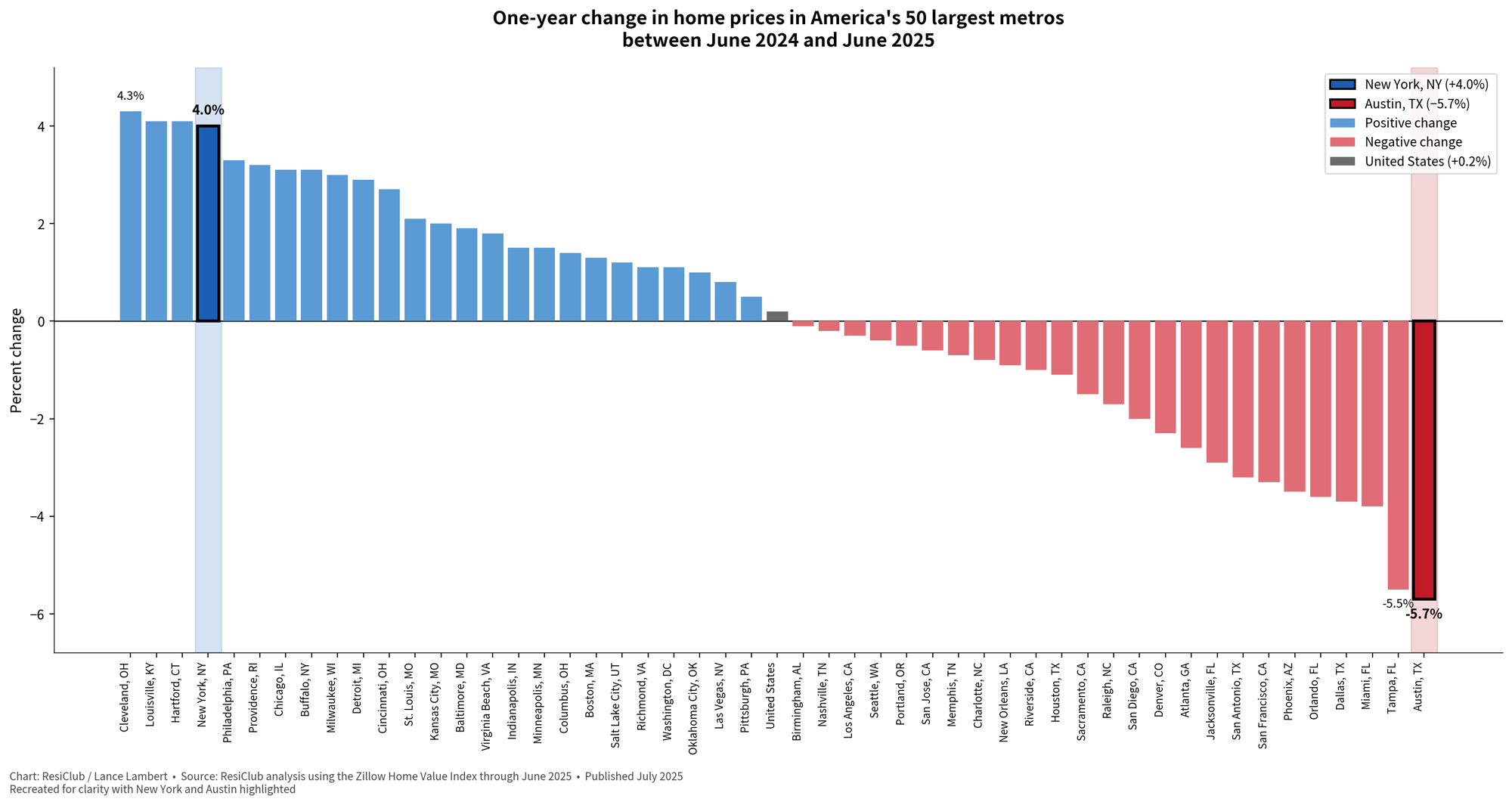
Why can’t New York consider option #2? In his defense, Mamdani has proposed small ideas to speed up permitting and allow more density. But much more has to happen. The hurdles to building in New York are infamous. And at the same time the city has delivered a full rent freeze on the existing stabilized stock while tightening the rules around eviction and building standards. The new restrictions far outweigh any reforms. Supply will likely get worse.
The great irony is that many existing New York landlords would likely oppose both strategies. Rent controls clearly limit profit. But removing the bottlenecks to supply also limits profit. More competition means lower rents and demands to compete with a better product. If you own a market-rate apartment in New York, you are raking it in. No new housing in a hot job market? Great!
Just ask Austin landlords how they are feeling. They are reducing rents after overbuilding for the situation. That is what the market often does. Who benefits? Real people who can now get into a hot job market at a lower price.
Across our economy, greedy business people are painted with the stain of our affordability issues. But in the biggest problem areas of housing, healthcare, and education, the core problem is centrally controlled markets crippled by a series of policies that limit supply and drive costs up.
Holding rents low feels good and can create a short-term win for specific individuals. But the long term is disastrous — and system-wide.
Anyone who stops to think knows these basic facts. But the vibes are real. We must mandate solutions. The kids have new ideas and a new approach! We need to listen and try!
No. Sorry. The ideas are old. They have been tried and failed countless times in a myriad of places.
But here we go again.
All while simple answers exist — and they don’t cost much. More freedom will drive more supply. And lower costs will follow.
Good Links
The bad ideas on both sides of the aisle: JD Vance and the new right offer their own form of socialism. My summary of the situation here.
Earth is flat #2: a good and quick breakdown of the ludicrous NYC grocery plan.
There is strong case that seizing property from landlords is the real goal in NY.
The comptroller of NY admits: “it costs too damn much” to build.
Bootleggers and baptists. Do gooders and incumbent businesses both love regulation and often make unusual alliances.
Bill Maher calls it like it is:
Hey Lew, I agree with a fair amount of this, particularly that increasing supply matters and overly restrictive zoning and permitting can make an affordability problem much worse. Austin certainly provides some compelling evidence: we've built like crazy, and rents have come down.
But having lived through the Austin version of this experiment, I'm less convinced that removing regulatory barriers and letting the market respond gets us all the way there. Developers ultimately respond to profit incentives, which is fine — but those incentives don't necessarily produce the housing a community actually needs. Certainly in Austin, we've seen plenty of promises around "affordable" housing get watered down or never materialize. The market is very good at building when there's money to be made; it's less good at making sure teachers, service workers, young families and lower-income residents can afford to live there.
There's also a cost to all that development that doesn't show up in the price of a new apartment. My own neighborhood has been inundated with new construction, while roads, traffic infrastructure and services haven't remotely kept pace. We're dealing with far more traffic, litter, accidents and other quality-of-life issues, and a number of longtime families on my street are selling because they're fed up. That's a cost too — it's just being borne by the existing community rather than the developer.
So I'm with you on "build more," and on removing unnecessary barriers to doing it. I just think the Austin experience argues for something a little more nuanced than letting supply do the heavy lifting: make it easier to build, yes, but also make sure growth brings genuinely affordable housing and the infrastructure needed to support it. More supply is hugely important — I just don't think it's a panacea for affordability or good urban policy.
Thank you Lew! I learned a lot reading this! Best, Pam Cohen